Arcana Mundi Expeditions

Luxury Amazon Wildlife Tours


Amazon Wildlife Tours

Golden Lion Tamarin, Poço das Antas Biological Reserve, Rio de Janeiro, Brazil.
Photo: Mariana Munn. Amazon Wildlife Tours.


If your quest is to experience nature's rarest wildlife,

Arcana Mundi is the place to begin...


A vast sinkhole falls precipitously into the Earth, holding within it a galaxy of Red-and-Green Macaws that live in the cavities of the pink sandstone walls. High in the Andes, a lost world of volcanos, lagoons and grasslands gives sanctuary to the endangered Andean Condor and the rarest species of flamingos. In the Atlantic coastal forest near Rio, the amazing Golden Lion Tamarins have been rescued from near extinction. Normally it is hard to get the conservation biologists to open the site even to scientists, but we know how to get it open for you -- and you will observe these rare creatures face to face. Our expeditions to nature's secret places only are possible thanks to the lifelong research and exclusive access of Dr. Charles A. Munn, noted ornithologist and pioneer of conservation through ecotourism. Our extreme nature experiences are reserved for just a few scientists, special film crews, professional photographers and you.


Jaguar CampAmazon Wildlife ToursWolf CampAmazon Wildlife ToursWhite Waters & BlackAmazon Wildlife ToursInca Trail


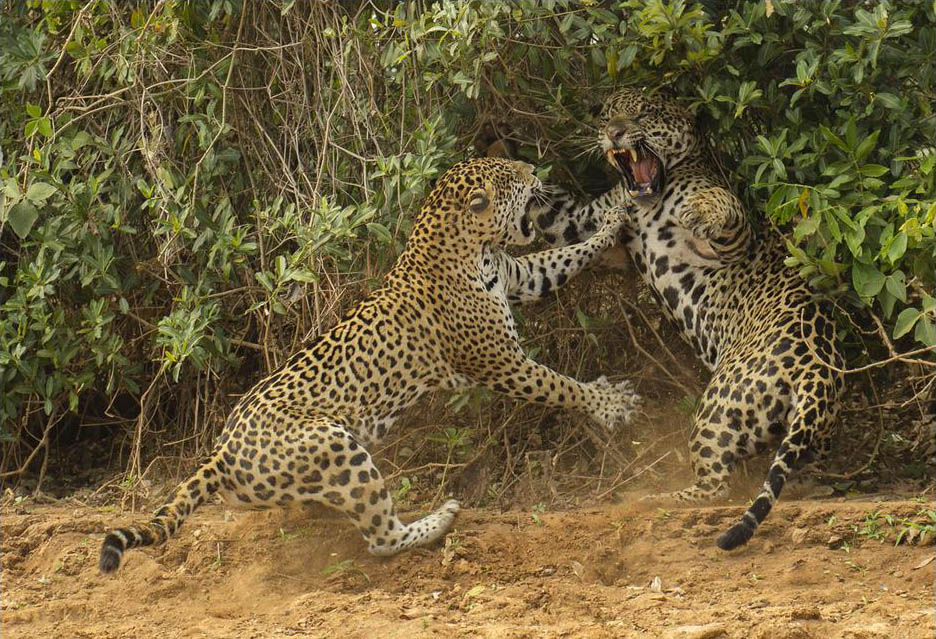
Wild Jaguar, Pantanal, Central Western Brazil.
Photo: SouthWild Jaguar Camp. Amazon Wildlife Tours.


Never before have Jaguars and humans lived in such peace and harmony...

-- Dr. Charles A. Munn, Founder, SouthWild Jaguar Camp and SouthWild Pantanal


SouthWild Jaguar Camp

Location: Meeting-of-the-Waters State Park, Pantanal, Brazil. Reserve size: 270,000 acres. Wildlife it protects: Jaguars, Brazilian Tapirs, Giant Otters, Brown Capuchin Moneys, Black and Gold Howler Monkeys, Silvery Marmosets and 82 species of large birds, including Agami Herons, Black-collared Hawks, Sunbitterns, Sungrebes, Bare-faced Curassows, Great Potoos, Jabiru Storks and a profusion of other water and forest birds.

Located in central-western Brazil, the Pantanal is a UK-sized mosaic of seasonally-flooded savannahs and tropical forests that features the finest wildlife viewing in Latin America. This area harbors a world-record 82 species of large birds, thousands of which can be seen during a one-hour drive on the raised Transpantaneira Road, the only all-season route that penetrates the heart of this enormous wildland. The Pantanal harbors 4,000-7,000 Jaguars, including the heaviest specimens in the world. A male Jaguar in our region recently weighed in at 310 pounds (144 kilos).

At the end of the Transpantaneira Road winds a labyrinth of rivers on which our specially-trained trackers and boatmen have shown Jaguars to guests 397 times in 220 guest days in the 2007 and 2008 dry seasons. This location is the site of the 270,000-acre Meeting-of-the-Waters State Park, one of the three largest protected areas in the entire Pantanal. No other location in the world can offer anything like this number of Jaguars per day. Most guests also see Tapirs and Giant Otters. Never before, anywhere, in the history of the world have Jaguars and humans lived in such peace and harmony. Come see our Jaguars and make history. Most of the Jaguars in this huge "Jaguar park" appear over and over again, and we now have both a complete face dossier of the 15 most frequently-seen cats and a growing number of data points that allow us to map the overlapping territories of these mighty cats.

More about SouthWild Jaguar Camp.


Hyacinth Macaw.
Photo: Pete Oxford. Amazon Wildlife Tours.


Saving the Amazon Rainforest in style...

-- Kimberly Fay, LuxuryLink.com


Arcana Mundi is like a generous, adventurous friend who's always at your side as you travel to some of the world's most enchanting destinations. With its SouthWild Wolf Camp expedition, this gracious companion guides you into the compelling beauty of northeastern Brazil's Parnaiba Headwaters National Park. Your journey begins and ends in Barreiras with a stay at the luxurious Hyacinth Valley Lodge, established by South American conservationists to guard rare species. You will find the surrounding backdrop of palm-studded valleys, red-rock cliffs and mesas ideal for close-up wildlife encounters and trophy photo opportunities.

From a discreet blind, you will witness the ballet of Hyacinth Macaws, the world's largest parrots, as they gather to search for palm nuts. In the comfort of a hammock, you will await the arrival of the endangered Maned Wolf. Tool-using Brown Capuchin Monkeys and flocks of Red-and-Green Macaws are among the other amazing creatures you will observe. From chats with your native guides to swimming in the local river and enjoying evening caipirinhas, this is a unique adventure through the mysterious spirit of the Amazon.

Discover the wildlife treasures of the Amazon on this fascinating 5-night escape.

As featured on PBS: The Real Macaw.


SouthWild Wolf Camp

Location: Parnaíba Headwaters National Park, Northeastern Brazil. Reserve size: 19,000 acres within and adjacent to the 1.8-million-acre Parnaíba Headwaters National Park. Wildlife it protects: Hyacinth Macaws, Red-and-Green Macaws, Blue-and-Gold Macaws, Burrowing Owls, Great Potoos, Maned Wolves, Jaguars, tool-using Brown Capuchin Monkeys and Black-and-Gold Howler Monkeys.

Every half century or so, an amazing new wildlife destination bursts onto the South American scene. Such is the case for SouthWild Wolf Camp of the sunny, dry forests of central Brazil. No other destination in Brazil offers so much charismatic wildlife in so little time -- and with so much comfort.

This new lodge complex is located at Brazil's new, 1.8-million-acre Parnaiba Headwaters National Park. At one-third the size of New Jersey, this park is Brazil's largest park outside the Amazon and protects far more dry tropical forest than any other reserve on Earth. Only 10% of the world's original dry tropical forest remains today, while half of all wet tropical forest still stands, so the Parnaiba Headwaters National Park is of exceptional conservation importance.

From the comfort of SouthWild Wolf Camp, you can see some of the most exciting wildlife in Brazil. The Park harbors more than 1,500 Hyacinth Macaws -- 50-100 times more than any other national park. It also is the most important reserve for the endangered Maned Wolf, which is the world's largest and most beautiful wild canid. Finally, Parnaiba Park is the only place on Earth where Brown Capuchin Monkeys demonstrate the world's most complex tool use by nonhuman primates. This incredible display of intelligence was reported for the first time in 2004, initially in National Geographic Magazine and then worldwide in a BBC TV documentary. There is only one place to see all of these amazing creatures, and that is SouthWild Wolf Camp.

More about SouthWild Wolf Camp.


The rarely-seen Golden-backed Uakari (Cacajao melanocephalus), Jaú National Park, Brazil.
Photo: Luiz Claudio Marigo. Amazon Wildlife Tours.


A celebration of life...


-- Dr. Charles A. Munn


White Waters & Black: The Two Worlds of the Amazon

Location: Mamirauá Reserve and Jaú National Park within the Central Amazon Conservation Corridor. Corridor size: 15,000,000 acres, by far the largest stretch of protected tropical rainforest on Earth. This expedition visits both ends of this gigantic conservation complex of the central Amazon. Wildlife it protects: Common Woolly Monkeys, Pink Dolphins, Gray Dolphins, Scarlet Macaws, Harpy Eagles, Black Caimans, Spectacled (or White) Caimans, Red Howler Monkeys, Brown Capuchin Monkeys, Common Squirrel Monkeys, Vanzolini's Squirrel Monkeys, Festive Amazon Parrots, herons, egrets, Neotropic Cormorants, Hoatzins as well as the rare Golden-backed Uakari and White Uakari monkeys.

Miraculously, the greatest wilderness on Earth, the Amazon, still resists our most strenuous efforts to force it to our will. Despite dire reports over the past four decades, more than three-quarters of the Amazon forest is still standing, storing trillions of tons of carbon. The Amazon basin, strictly defined, is the size of the United States, and that doesn't even include the mighty Orinoco, which anywhere else in the world would seem huge, but in the context of the world’s great rivers, is dwarfed by the Amazon.

How did the Amazon develop over geological time? What are the facts about the biology, geology and anthropology of the pre-Columbian Amazon? What has happened to the Amazon since 1492 and what are the possible futures of the world’s greatest rainforest? What can we do to change the outcome for the better? These questions and more are the topics to be examined on a unique voyage of discovery to the two great and very different worlds of the Amazon rainforest: The prolific Whitewater World of the Amazon River and the mysterious Blackwater World of the Rio Negro.

The expedition will travel to the two extremes of the greatest protected area of tropical rainforest on Earth. It will begin with a visit to the greatest of the reserves in the Whitewater World -- the 2.7-million-acre (1.1-million-hectare) Mamirauá Reserve, which lies at the western end of the 15-million-acre (six-million-hectare) Central Amazon Conservation Corridor. Mamirauá is an amazing reserve that protects the largest flooded forest in the world -- a huge triangle of rainforest that lies between the confluence of the Amazon River and the much smaller Rio Japurá. In most countries of the world, the Japurá would be considered an enormous river, but in the water world of the Amazon, the Japurá is like a tiny European stream that one might expect to hear extolled in a Schubert lied such as Die Forelle (The Trout). The Japurá is, in fact, the size of the Thames, Rhein or Danube. The expedition will continue and conclude at the eastern end of the Conservation Corridor with a contrasting visit to the world’s largest and most pristine reserve of tropical rainforest in the Blackwater World -- the 5.8-million-acre (2.3-million-hectare) Jaú National Park.

More about White Waters & Black: The Two Worlds of the Amazon.


luxury Inca Trail

Before Phuyupatamarca, Inca Trail to Machu Picchu.
Photo: Mylene d'Auriol Stoessel. Amazon Wildlife Tours.


Inca Trail to Machu Picchu

One of the most popular treks in the world is, without doubt, the Inca Trail. It combines ancient archaeological sites, snow-covered mountain scenery, cloud forests and a rich biodiversity that includes many different species of birds and beautiful orchids. The trek ends at "The Lost City of the Incas" -- Machu Picchu. Here, travelers discover the highly sophisticated architecture of the Incas that amazed the American explorer, Hiram Bingham, when he discovered the citadel in 1911. Although the trek is rated as moderate; before starting, we strongly suggest spending at least two days at this elevation to totally adjust to the altitude.

The cities of the Incas were connected by well-made roads, of which the one from Cuzco to Machu Picchu, now called the Inca Trail, has become the most famous trekking route in South America. Our five-day program allows the traveler time to explore and enjoy the amazing archaeological sites, landscapes and nature along the way. While most other programs force trekkers to speed through the stunning high-altitude Inca Trail, We take the time to enjoy this once-in-a-lifetime experience. We camp the first three nights, enjoy great meals and sturdy tents. The hikes average six to seven hours each day, including some time to explore sites we pass through and to take in the unparalleled scenery. On the fourth afternoon, we arrive at Machu Picchu after the crowds have left, and have time to explore the tranquil ruins. After a well-deserved night in a comfortable hotel, we return to Machu Picchu to see the ruins in the perfect morning light. In the afternoon, we return to Cuzco by train. This program is specially designed to offer a more relaxed trek and a deeper understanding of Inca culture.

Your private trekking party will consist of yourselves, a select guide who is an expert in archaeology and ecology, a chef, a chief porter and two porters per trekker. The porters will carry the tents, sleeping bags and matresses, cooking gear, food, drinks and other necessary camping equipment, all of which will be provided. They also will carry each trekker's pack of personal items. Departure from or return to Ollantaytambo, instead of Cuzco, is optional. For a shorter version of the Inca Trail, we recommend our 4-day Inca Trail Classic trek. For a short version, see the Royal Inca Trail. A list of what to bring and a commentary about the archaeological sites, landscapes and nature appear in the Pre-Departure Information.

More about Inca Trail to Machu Picchu


Contact Arcana Mundi Expeditions


2345 Broadway, Suite 638, New York, NY 10024. Tel: +001 212 787 0500. Email: expeditions@arcanamundi.com

© 2011 Inka's Empire Corporation. Amazon Wildlife Tours. All rights reserved.

Amazon Wildlife Tours

Amazon Wildlife Tours

Amazon Wildlife Tours

Amazon Wildlife Tours

Amazon Wildlife Tours

Amazon Wildlife Tours

Amazon Wildlife Tours

Amazon Wildlife Tours

Amazon Wildlife Tours

Amazon Wildlife Tours

Amazon Wildlife Tours

Amazon Wildlife Tours

Amazon Wildlife Tours

Amazon Wildlife Tours

Amazon Wildlife Tours

Amazon Wildlife Tours

Amazon Wildlife Tours

Amazon Wildlife Tours

Amazon Wildlife Tours

Amazon Wildlife Tours

Amazon Wildlife Tours

Amazon Wildlife Tours

Amazon Wildlife Tours

Amazon Wildlife Tours

Amazon Wildlife Tours

Amazon Wildlife Tours

Amazon Wildlife Tours

Amazon Wildlife Tours

Amazon Wildlife Tours

Amazon Wildlife Tours

Amazon Wildlife Tours

Amazon Wildlife Tours

Amazon Wildlife Tours

Amazon Wildlife Tours

Amazon Wildlife Tours

Amazon Wildlife Tours

Amazon Wildlife Tours

Amazon Wildlife Tours

Amazon Wildlife Tours

Amazon Wildlife Tours

Amazon Wildlife Tours

Amazon Wildlife Tours

Amazon Wildlife Tours

Amazon Wildlife Tours

Amazon Wildlife Tours

Amazon Wildlife Tours

Amazon Wildlife Tours

Amazon Wildlife Tours

Amazon Wildlife Tours

Amazon Wildlife Tours

Amazon Wildlife Tours

Amazon Wildlife Tours

Amazon Wildlife Tours

Amazon Wildlife Tours

Amazon Wildlife Tours

Amazon Wildlife Tours

Amazon Wildlife Tours

Amazon Wildlife Tours

Amazon Wildlife Tours

Amazon Wildlife Tours

Amazon Wildlife Tours

Amazon Wildlife Tours

Amazon Wildlife Tours

Amazon Wildlife Tours

Amazon Wildlife Tours

Amazon Wildlife Tours

Amazon Wildlife Tours

Amazon Wildlife Tours

Amazon Wildlife Tours

Amazon Wildlife Tours

Amazon Wildlife Tours

Amazon Wildlife Tours

Amazon Wildlife Tours

Amazon Wildlife Tours

Amazon Wildlife Tours

Amazon Wildlife Tours

Amazon Wildlife Tours

Amazon Wildlife Tours

Amazon Wildlife Tours

Amazon Wildlife Tours

Amazon Wildlife Tours

Amazon Wildlife Tours

Amazon Wildlife Tours

Amazon Wildlife Tours

Amazon Wildlife Tours

Amazon Wildlife Tours

Amazon Wildlife Tours

Amazon Wildlife Tours

Amazon Wildlife Tours

Amazon Wildlife Tours

Amazon Wildlife Tours

Amazon Wildlife Tours

Amazon Wildlife Tours

Amazon Wildlife Tours

Amazon Wildlife Tours

Amazon Wildlife Tours

Amazon Wildlife Tours

Amazon Wildlife Tours

Amazon Wildlife Tours

Amazon Wildlife Tours

Amazon Wildlife Tours

Amazon Wildlife Tours

Amazon Wildlife Tours

Amazon Wildlife Tours

Amazon Wildlife Tours

Amazon Wildlife Tours

Amazon Wildlife Tours

Amazon Wildlife Tours

Amazon Wildlife Tours

Amazon Wildlife Tours

Amazon Wildlife Tours

Amazon Wildlife Tours

Amazon Wildlife Tours

Amazon Wildlife Tours

Amazon Wildlife Tours

Amazon Wildlife Tours

Amazon Wildlife Tours

Amazon Wildlife Tours

Amazon Wildlife Tours

Amazon Wildlife Tours

Amazon Wildlife Tours

Amazon Wildlife Tours

Amazon Wildlife Tours

Amazon Wildlife Tours

Amazon Wildlife Tours

Amazon Wildlife Tours

Amazon Wildlife Tours

Amazon Wildlife Tours

Amazon Wildlife Tours

Amazon Wildlife Tours

Amazon Wildlife Tours

Amazon Wildlife Tours

Amazon Wildlife Tours

Amazon Wildlife Tours

Amazon Wildlife Tours

Amazon Wildlife Tours

Amazon Wildlife Tours

Amazon Wildlife Tours

Amazon Wildlife Tours

Amazon Wildlife Tours

Amazon Wildlife Tours

Amazon Wildlife Tours

Amazon Wildlife Tours

Amazon Wildlife Tours

Amazon Wildlife Tours

Amazon Wildlife Tours

Amazon Wildlife Tours

Amazon Wildlife Tours

Amazon Wildlife Tours

Amazon Wildlife Tours

Amazon Wildlife Tours

Amazon Wildlife Tours

Amazon Wildlife Tours

Amazon Wildlife Tours

Amazon Wildlife Tours

Amazon Wildlife Tours

Amazon Wildlife Tours

Amazon Wildlife Tours

Amazon Wildlife Tours

Amazon Wildlife Tours

Amazon Wildlife Tours

Amazon Wildlife Tours

Amazon Wildlife Tours

Amazon Wildlife Tours

Amazon Wildlife Tours

Amazon Wildlife Tours

Amazon Wildlife Tours

Amazon Wildlife Tours

Amazon Wildlife Tours

Amazon Wildlife Tours

Amazon Wildlife Tours

Amazon Wildlife Tours

Amazon Wildlife Tours

Amazon Wildlife Tours

Amazon Wildlife Tours

Amazon Wildlife Tours

Amazon Wildlife Tours

Amazon Wildlife Tours

Amazon Wildlife Tours

Amazon Wildlife Tours

Amazon Wildlife Tours

Amazon Wildlife Tours

Amazon Wildlife Tours

Amazon Wildlife Tours

Amazon Wildlife Tours

Amazon Wildlife Tours

Amazon Wildlife Tours

Amazon Wildlife Tours

Amazon Wildlife Tours

Amazon Wildlife Tours

Amazon Wildlife Tours

Amazon Wildlife Tours

Amazon Wildlife Tours

Amazon Wildlife Tours

Amazon Wildlife Tours

Amazon Wildlife Tours

Amazon Wildlife Tours

Amazon Wildlife Tours

Amazon Wildlife Tours

Amazon Wildlife Tours